Friday, January 21, 2011

A Trip to the Bog

Last Monday, Martin Luther King Day, Art and I took a break from mudding sheetrock seams and drove up the the Sax Zim bog area for some birding.
Maybe I should clarify: Art did all of the mudding. Art also did all of the driving. Driving and slowing down and stopping so I could look for birds. I called him "my faithful driver Kato."
Art is the BEST. He isn't a birder but will patiently drive through a heavy snowfall on unplowed back roads for hours so I can look for birds.
Back to the story.
Hasty Brook is only about 30 miles from the bog. The weather really was pretty crummy- very overcast and snowing. Art had the truck in four wheel drive on most of the back roads and was able to pull a fellow and his little sedan out of a ditch.

Moving along slowly I spotted a movement off in the distance. Can you see it in the photo above?

A magnificent Great Gray Owl. His head moved back and forth, scanning for a meal. Art stopped the truck (and took out a book) while I grinned, watching the owl in the distance. He lifted off and glided to a tree closer to us. It was a perfect view.

The photo above is far from perfect but I was so thrilled to catch the owl take flight. It flew across the road in front of us and landed in a field on the other side.

We never approached the owl, but when it flew closer to the truck , I felt we were disturbing its hunt so we slowly drove away.

Moving along down the snowy roads I spotted a familiar silhouette T'd up high in a black spruce. It was this Northern Hawk Owl. Again, this bird was quite a way off and my photos are not very sharp, but they they're good enough for me!

As we watched the Northern Hawk Owl left his perch, flew to the ground and snatched up a meal. It flew back up to a snowy branch and ate its meal.
Boreal Chickadee
There are a few feeding stations in the bog that are maintained by local residents. As we pulled up to one of them and stopped the truck, I immediately heard the raspy, hoarse version of "chickadee-dee-dee" sung by a Boreal Chickadee. I had really hoped to find one. I've only seen two of them in the bog before. There was no one else to be seen on that road so Art turned the truck off right in the middle of the road and I rolled the window down. There were many Black-capped Chickadees and Pine Grosbeaks. I could hear a Boreal Chickadee out both truck windows- there were two of them! I tried my best to get them both in view at once but couldn't.

I love this picture of a Black-capped Chickadee tapping at a seed held in its toes, surrounded by lichen and snow-covered branches.
It was such a wonderful day. With the poor weather, I never expected to see so many wonderful winter visitors to the bog. It is such a special place. I've visited several times and the bog never fails to show and teach me something wonderful.
This year, for the first time, I am unable to attend the Sax Zim Bog Festival of Birds. Registration closes on January 31, so there is still time to sign up. I've always had a great time at the festival so if you're looking for a community based festival with experienced guides, fabulous local food, and of course the special birds of the far north, you really should go.

Saturday, January 08, 2011

A Hoary Redpoll Story

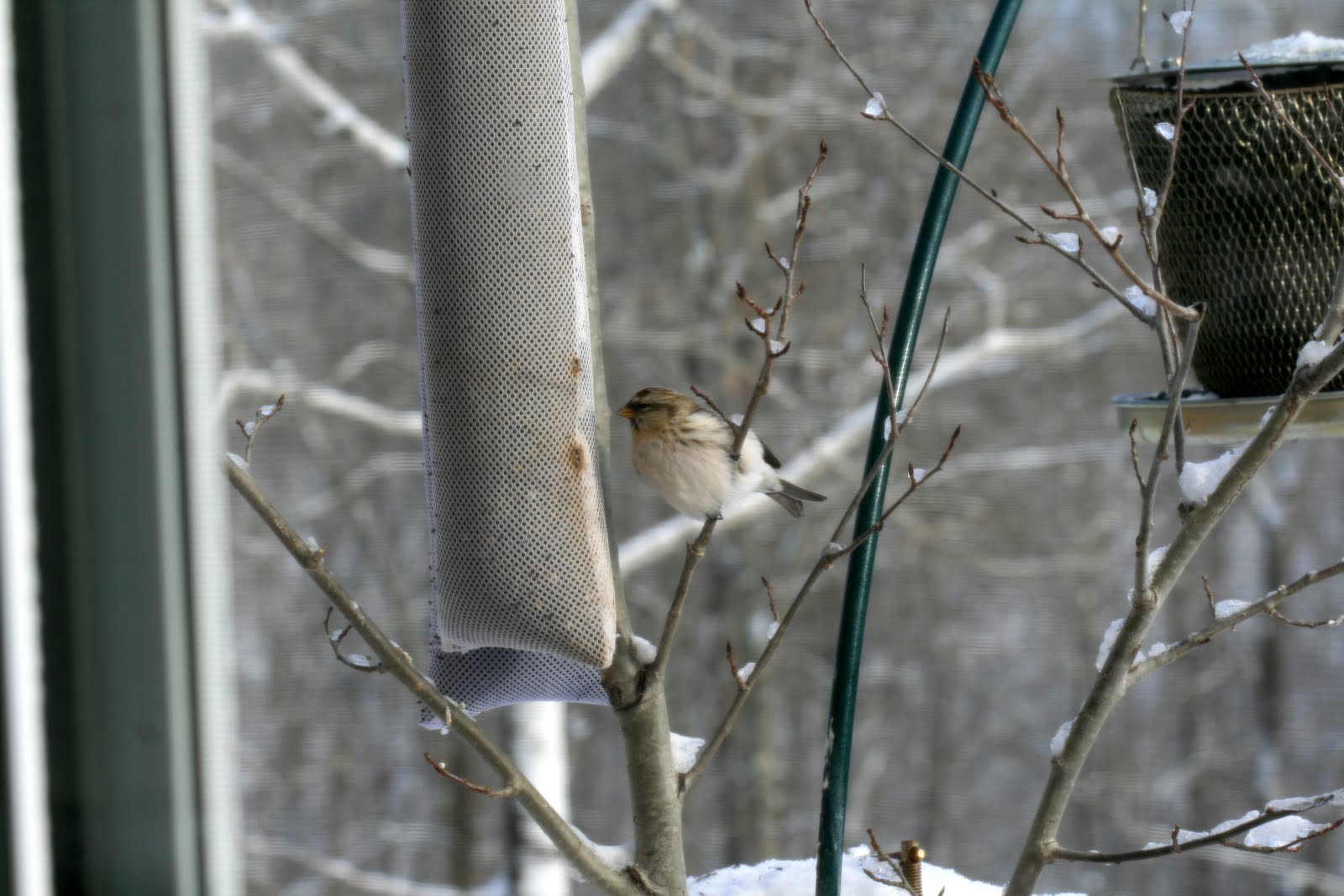
Last Sunday when Art and I made our trip up to Hasty, and the flock of Repolls descended on the feeders, I was so happy to see these little finches. I noticed one fluffy bird tucked down in the bare brush. It was on the slope down to the creek, out of the wind and facing into the sun. It caught my attention because it was so fluffed up and didn't come up to feed with the rest of the Redpolls. For nearly two hours I kept an eye on the bird. When I got my binoculars on the bird I noticed that it was a bit whiter than the others. I had a flash of excitement at the thought that it might be a Hoary Redpoll.
The little bird in question finally flew up to the feeders on the second story balcony and I sot to check out the field marks. The photo above was taken through a window screen but shows the white, unstreaked undertail coverts.
This photo shows the shorter, "stubby" beak, giving the face a pushed in appearance. It also shows the finer, fainter steaking on the flanks.

Another field mark is the clear, white rump.

I love this one. It's as if she knows she's being photographed and knows just how lovely she is.
I felt pretty sure I had a Hoary Redpoll identified, but I'd only seen one twice before and those times had had them pointed out to me so I sent my photos off to my birding mentor
Hap in New Hope. He confirmed it! Richard sent me photos and information from the Stokes Guide too.
Many birders go for years hoping to see a Hoary Redpoll and now I got to add it to my
Hasty Brook yard list.
That's just another reason that I know how lucky we are to have such a special place.

Wednesday, January 05, 2011

A Golden Day

Life Bird: Golden Eagle!!
Yesterday was one of those unforgettable days. I set out in the sub-zero morning, my car loaded with birding gear, extra boots, hats, mittens and gloves. My destination was the National Eagle Center about 100 miles south in Wabasha, Minnesota. I was meeting my birding friend Ruthie. We were attending a class on Golden Eagle identification followed by a field trip into the bluffs area nearby to scout for Golden Eagles.

On January 15, Scott Mehus, the Education Director for the National Eagle Center will be coordinating the Seventh Annual Wintering Golden Eagle Survey. Last year 140+ observers counted nearly 100 Golden Eagles in the survey area!

Ruthie and I took notes during the seminar, quickly memorizing the field marks differentiating Golden Eagles form Bald Eagles. We were fortunate to snag a ride with Scott for the field trip so we could get extra information and a narrative during our ride through the bluffs.

A few miles across the river into Wisconsin Scott pulled over to point out an area where he knew a pair of Goldens had an established territory. He had explained that unlike Bald Eagles, which like to choose perches near the tops of trees or out on the edges of clear areas, Goldens more often were found within the tree canopy. We scanned the bluffs for dark shapes and spotted a pair, far off in the distance.

A lone Golden Eagle


Back in the van we headed off to another pair's territory. Again, they were quite a way off and appeared as lumps to me.

Our last stop was another pair's territory. We were positioned between two bluffs and Scott told us that the pair routinely would fly from the bluff on the left to the east, across the road and up to a bluff on the west to roost for the night. He said it would be our best chance to see Goldens in flight. Within minutes of his explanation he shouted "Here comes the male!" I left my camera in the van and simply watched with binoculars, in awe of the magnificent bird overhead. Just as the male crossed over to the other bluff, the female came out from behind the tree line to to east. She was gorgeous! Again, I purposely left my camera in the case so I could just watch. As both eagles disappeared behind the trees in the west, Scott mentioned that they might come back and roost in a visible spot. Sure enough, the female did. Finally, I took out my camera and grabbed a shot of her silhouette in the far distance. After a few moments, we started back to the van to head back when someone shouted that one of the eagles was back up in the air.

It was the male flying back over our heads. The male went on to fly back and forth across the sun exposed face of the bluff to our left. He was actively hunting! We learned that the majority of the Golden Eagle's prey in this area is squirrels and Wild Turkeys. I grabbed my camera (without mittens) and took photo after photo. It was so cold my fingers went numb and my camera couldn't process the photos as fast as I was taking them. Auto focus started to get sluggish and I had to quit.

But I had enough.

Life bird!

I smiled the whole way home.


Note to self: Buy hand warmers to keep in the car.


Anyone within driving distance to the National Eagle Center should consider attending one of Scott's seminars. There is another coming up this Saturday, January 8 at 1pm. They are always looking for volunteers for the Wintering Golden Eagle Survey, always on the third Saturday of January. If you can't visit this year, think about next year. I would like to go to the seminar again next year. It's terrific information and I would like to try to see an immature Golden Eagle.

Monday, January 03, 2011

A New Year at Hasty Brook

Minnesota weather kept us from our first weekend of the New Year up at Hasty Brook. Severe weather warnings of freezing rain turning to snow as the temperatures dropped to near zero, added to strong winds, kept us home doing house chores on Saturday. Sunday was supposed to be clear and cold so we set the alarm for early and hit the road by 8 am. The temperature was just below zero but we needed a Hasty fix! I bought Art and I snowshoes for Christmas and while I ran upstairs to fill the feeders and check on the birds, Art strapped his on and went for a walk. He said he could hear water gurgling downstream by the old beaver dam and when he punched the ice with his ski pole it broke through! He crossed back over the creek upstream of the dam and decided to walk the creek back to our cabin.
Upstairs at the feeders on the balcony, it looked like all the regulars were there. Chickadees, White and Red-breasted Nuthatches and a sprinkling of Goldfinches. I shoveled off the deck and set to work filling feeders. Even with a hat on I could hear birds coming through the woods. I looked up in time to see a good sized flock flying in from across the creek: REDPOLLS!
I love these tiny winter finches. I had heard that this isn't being a good winter for northern finches but sure was wishing hard to see a few at Hasty. I kept my movements slow and deliberate and eventually one Redpoll flew up from the hazelnut brush. Seconds later I was surrounded! If I stood very still they would land on my head and shoulders. What a thrill!

I cleared most of the snow and ice from the railing, spread some thistle and soon they were lined up eating.

The sun stays low in the sky during January in northern Minnesota so by early afternoon the sun was already shining weakly in the southwest. Even the weak sun made their red caps shine.

On such a cold day, the Redpolls were really gobbling up the thistle.

A big shadow overhead sent the birds scrambling for cover. It was this handsome Hairy Woodpecker coming to check out the suet feeder.

This little Downy Woodpecker either needs a comb or is having a devilish thought...

I have a few feeders down below on shepard's hooks. This one has been bear chewed and repaired many times. I had to use copper electrical wire to make a new handle and the lid won't lay flat. Red squirrel likes it fine that way.

On the drive up I mentioned to Art that neighbors had Pine Grosbeaks at their feeders and that I'd really like to add them to my Hasty yard list. While I was counting Redpolls in the birch I noticed two larger birds. Even with binoculars it was hard to tell, they were so back-lit. One flew down to the ground under the balcony. It was a beautiful male Pine Grosbeak! After a few minutes the female flew down to the maple to check out the feeder action. Isn't she beautiful?

The male wouldn't come any closer but the female finally landed on the railing.

A new yard bird at Hasty!
Good Neighbor Mark dropped by and mentioned that there are Evening Grosbeaks at a neighboring farm.
Maybe next trip!

Saturday, January 01, 2011

Resolved

I'm not much for New Year's resolutions.
However,
in the New Year of 2011
I hope to
laugh more,
listen more,
love better.
I want to
care for my family,
my home,
and Hasty Brook.
I will
spend time with family
and friends,
and show them that I love them
every chance I get.
I am
grateful
for all of you
and plan to show you
just how much
you mean to me.
I WILL
blog again!
I have lots of catching up to do especially the progress in the building up at Hasty.
Stay tuned-

Thursday, August 19, 2010

Meet My New Friend

I found the coolest insect at Hasty last weekend. I'd seen another of these a few weeks ago and looked it up in my Kaufman Field Guide to Insects of North America. It looked like a relative of the Spotted Sawyer, a longhorn beetle I'd seen up there several times before. With some help from blogging/Facebook friend Cindy Mead I eventually identified this beetle as a Balsam Fir Sawyer, Monochamus marmorator.
Check out the horny protrusions around its neck. I would guess they would make it difficult to swallow this big fellow. Doesn't it kind of remind you of a studded collar?
I mentioned to Hap in New Hope that I had seen this cool insect and he told me that he'd once gotten a nasty bite from a longhorn beetle. When I zoomed in on its face I could see how that might happen. Look at the size of those pinchy mouth parts! It's probably a good thing I didn't know they could bite as I had held it for quite a long time. Thankfully, no bites.

We looked at each other for a long time.
Click to big-ify this photo. The eyes are really amazing. Kindly disregard the fact that I really needed a manicure and some lotion.

Check out the camouflage colors. The colors looked metallic in the sun.

I took loads of photos of this accommodating beetle and felt we were forming a bond but when it pooped on me I knew it was time to say good-bye.

am-scra eetle-ba!

Thursday, June 10, 2010

Potholes and Prairie Birding Festival in Carington, North Dakota

I stopped in St. Paul to pick up birding friend Virginia and the at the airport for Katdoc and off we went. About seven hours and a few hundred miles later we arrived in Carrington, exhausted. Settle in, unpack, a bite to eat and off to bed to wait for our 4AM alarm. Kathi's trip was scheduled to leave at 430 and mine at 5AM. We were most happy to find that Wren was here at the festival too. This morning we headed out to tour the Arrowwood National Wildlife Refuge with guide Bill Thompson. Thw weather wasn't terrific- cold, windy with rain or drizzle most of the day but I am NOT complaining. The views were spectacular, the birding wonderful and the company was great.


We got several fabulous looks at Upland Sandpipers.
Western Grebes that were displaying.

We came upon a few pairs of Marbled Godwits throughout the day. They were not as happy to see us as we were to see them.

Common Snipe were uncommonly beautiful and easy to find.

We got to watch a bison heard cautiously move away and then break into a run.
It was like seeing a piece of history
I was honored.
I'm short on narritive tonight as I'm really tired. Julie Zickefoose spoke this afternoon and there is a picnic dinner and music this evening. Should be fun.
All told, I believe our group saw 78 species today and I got 16 life birds!!!
~~
Western Grebe
Blue-winged Teal
Canvasback
American Avocet
Upland Sandpiper
Marbled Godwit
Semipalmated Sandpiper
Wilson's Phalarope
California Gull
Black Tern
Willow Flycatcher
Western Kingbird
Horned Lark
Sedge Wren
Clay-colored Sparrow
Yellow-headed Blackbird
Pardon the typo's...
Tomorrow is Pipits and Pie with Julie.


Friday, May 28, 2010

Spring Changes at Hasty

Lifer Mourning Warbler!
We spent last weekend up at Hasty and spring had brought new colors to our place. Everything had greened up and there were many trees, bushes and wildflowers in bloom. I brought along my copy of Trees and Shrubs of Minnesota and spent a good deal of time figuring out just what we have growing up there. I was particularly interested in the brush growing along the slope down to the creek just below our balcony. We would like to clear it just a bit to give us a better view of the creek and the critters down there but I really want to be careful to leave the plants that produce fruit for the wildlife. I know we have lots of beaked hazelnut bushes. They grow wherever there is a break in the canopy. Some of them can go. Using the book I was able to identify several choke cherry trees, june berry bushes, and two kinds of dogwood. These are all terrific fruit producers and I've seen the birds go after them in earlier seasons. We also have quite a few pretty spruce and balsam trees growing on the south-facing slope. If we thin a bit they'll have more room to grow. As I identify plants that I want to keep, I've been marking them with a spool of red plastic ribbon. We'll most likely wait to start thinning the brush in the fall after the nesting season is long over. Thanks go out to Deb at Sand Creek Almanac for suggesting this wonderful book.
Saturday we had an exciting visitor- Richard from At The Water made the long drive up from his home to see our place and give us advice on finishing the upstairs to turn it into our cabin. Richard is an amazingly multi-talented man has kindly offered his expertise in carpentry and electrical wiring! His visit on Saturday gave us an opportunity to get ideas and make some decisions on the placement of interior walls and a kitchen. Most of these decisions need to be firmed up before the wiring can be done. We had a great day, though chilly and very windy. In addition to driving all that way to help us out, Richard brought us a most thoughtful gift: a framed photo that I took from the balcony and posted on this blog last year! It will be the first picture that I hang up there and I'll be sure to post a photo of it. Thank you Richard.
Sunday morning dawned warmer and quite cloudy. I woke early (6am), made a pot of coffee and quietly slid open the patio door on the balcony. Armed with a big cup of strong coffee and my binoculars I stepped outside to be met by a morning chorus like no other: The warblers were here! Ovenbirds, Common Yellowthroats, Black and Whites.
There were Chestnut-sided Warblers everywhere!
Our building/campsite is surrounded on three sides by the creek and I could hear the
bee-bz-bz
of Golden-winged Warblers on all three sides (no pix this time). I saw Blackpolls, American Redstarts, Nashville and Palm Warblers. I kept hearing a louder song, not familiar. I put on jeans, long sleeves and hiking shoes, grabbed my camera and took off to find the singer. I got as close as I could to the song, settled in and waited. There were two birds singing that song, one on either side of a small clearing. There it was- a Mourning Warbler!! LIFER!! Two males sang dueling songs. I took tons of pictures, none of them great because of the gray skies, but good enough to verify my id. I posted a photo two years ago of a fledgling that I couldn't identify. Hap in New Hope thought it was probably a Mourning Warbler but I didn't count it on my life list because I couldn't make the id myself.
It was a very birdy day even without the warblers. Purple Finches and Rose-breasted Grosbeaks fought for time at the feeders.


These Purple Finch ladies were bickering.


This little Chipping Sparrow sat still just long enough for a quick snapshot. Song Sparrows, Hermit Thrushes and Veeries sang along the creek. White-throated Sparrows skulked around mostly hidden in the thick hazelnut bushes. A brilliant flash of red in a treetop across the creek- a Scarlet Tanager is new for my Hasty yard list.

My first decent (sort of) photo of a Kingfisher.


Sunday was the birdiest day I've ever had at Hasty Brook.

~~~~~~~~~~

We'll be buying lumber, light fixtures and wiring supplies for our next trip up north. With Richard's help and advice we will be making great progress in turning our "upstairs" into a comfy cabin/loft. As soon as it's finished we'll be able to open the doors and invite you all up to the Hasty Brook Birder's B&B!!